

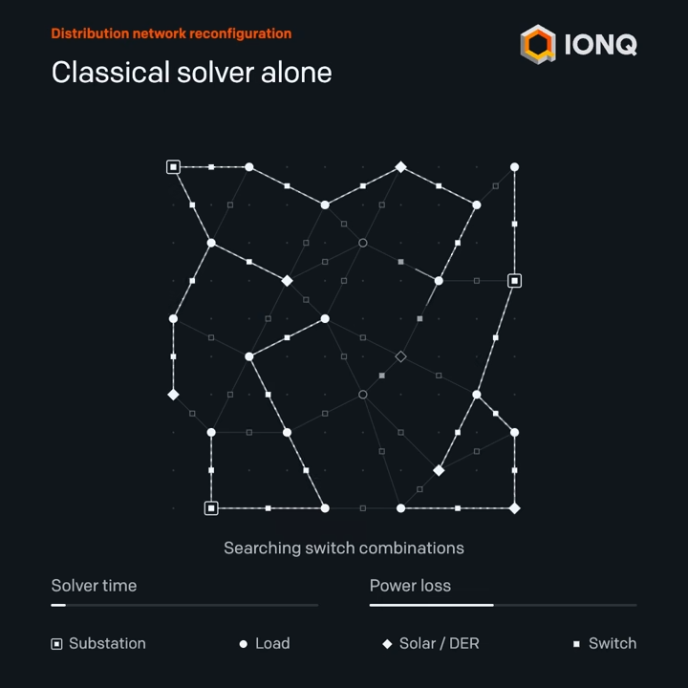
Municipal utility EPB, in collaboration with IonQ, has published experimental findings across three technical preprints demonstrating hybrid quantum-classical algorithms for distribution network reconfiguration (DNR). Funded under a $4 million grant from the National Institute of Standards and Technology (NIST), the project deployed EPB’s in-house Quantum Computing Fellows to execute optimization protocols on an on-premises IonQ Forte Enterprise trapped-ion system at the EPB Quantum Center in Chattanooga, Tennessee. The research benchmarks three distinct computational frameworks targeting active line-loss reduction and real-time switch allocation across distribution networks spanning up to 417 electrical buses.
Constraint-Preserving Mathematical Encodings and Hardware Implementations
DNR is a mixed-integer nonlinear programming challenge that requires selecting sectionalizing and tie switch states to minimize resistive dissipation while maintaining radial tree topologies without closed loops. Conventional quantum optimization approaches enforce radiality via penalty terms in Quadratic Unconstrained Binary Optimization (QUBO) matrices, introducing artificial energy barriers and barren plateaus. To bypass these issues, the joint research teams implemented three topology-preserving architectures directly on trapped-ion hardware:
| Technical Methodologies and Experimental Benchmarks across EPB-IonQ Preprints | ||
|---|---|---|
| Computational Architecture | Mathematical & Algorithmic Encoding | Demonstrated Hardware & Simulation Performance |
| Quantum-Enhanced Deep Reinforcement Learning (Q-DRL) | Double Deep Q-Network (Double DQN) with a 4-layer Parameterized Quantum Circuit (PQC) backbone and double decision-head masking. | Achieved 95.8% parameter reduction on the IEEE 33-bus system (9,156 parameters vs. 220,052 classically); IonQ Forte Enterprise execution yielded exact optimum (0.1396 MW loss) for 33 buses and within 0.30% of optimum for 69 buses. |
| Subspace LR-QAOA with Guided MISOCP Solver | Cycle-edge partitioning encoding spanning trees natively into multi-qubit W-state registers, generating mixed-integer programming (MIP) starts and variable hints. | Reduced median classical Gurobi MISOCP solver runtime to within 1% of target from 1,415.47 s down to 34.71 s on a 417-bus network using a fixed 29-qubit hardware budget. |
| Warm-Start Iterative Quantum Imaginary-Time Evolution (QITE) | Surrogate-assisted expectation matching with branch-exchange binary registers and a rolling-window stage queue for large networks. | Recovered global minimal-loss configurations across six benchmark networks; converged within 0.2% to 2.18% of published reference losses on remaining large-scale systems (up to 415 buses). |
Trapped-Ion Execution Realities and End-to-End Speedup Constraints
Hardware validation was carried out on the IonQ Forte Enterprise platform, utilizing a linear Paul trap with up to 36 barium or ytterbium ions (171Yb+) manipulated by pulsed 355 nm Raman laser beams and acousto-optic deflectors. Across the Q-DRL and iterative QITE workflows, quantum sampling successfully guided classical alternating current power flow (ACPF) engines to low-loss configurations despite device noise. However, physical runtime analyses reveal practical limits for utility deployment: in the two-stage MISOCP workflow, total end-to-end execution times remained dominated by quantum circuit overhead and classical pre- and post-processing on small-to-medium networks. The relative runtime gap between unguided classical solvers and end-to-end quantum-assisted pipelines only began narrowing on the 473-line, 417-bus system, establishing an empirical boundary where quantum-derived variable hints offset circuit compilation and shot latency.
The underlying preprints are indexed on arXiv covering Quantum-Enhanced Deep Reinforcement Learning here, Two-Stage Cycle-Edge MISOCP Reconfiguration here, and Warm-Start Iterative QITE here, with institutional program background detailed in IonQ’s Co-Innovation Report here.
In GQI Portal
The players behind the news
The team that writes QCR tracks every company, deal and technology in the GQI Factory, GQI's verified database of the quantum industry. Next up: every story linked to its players, coming to QCR's paid plans.
- Players Companies and institutions across the quantum industry, by segment.
- Scorecards How the players compare on hardware, software, funding and more.
Newsletter
QCR Alerts in your inbox
The latest reporting and analysis from Quantum Computing Report. Free, unsubscribe any time.